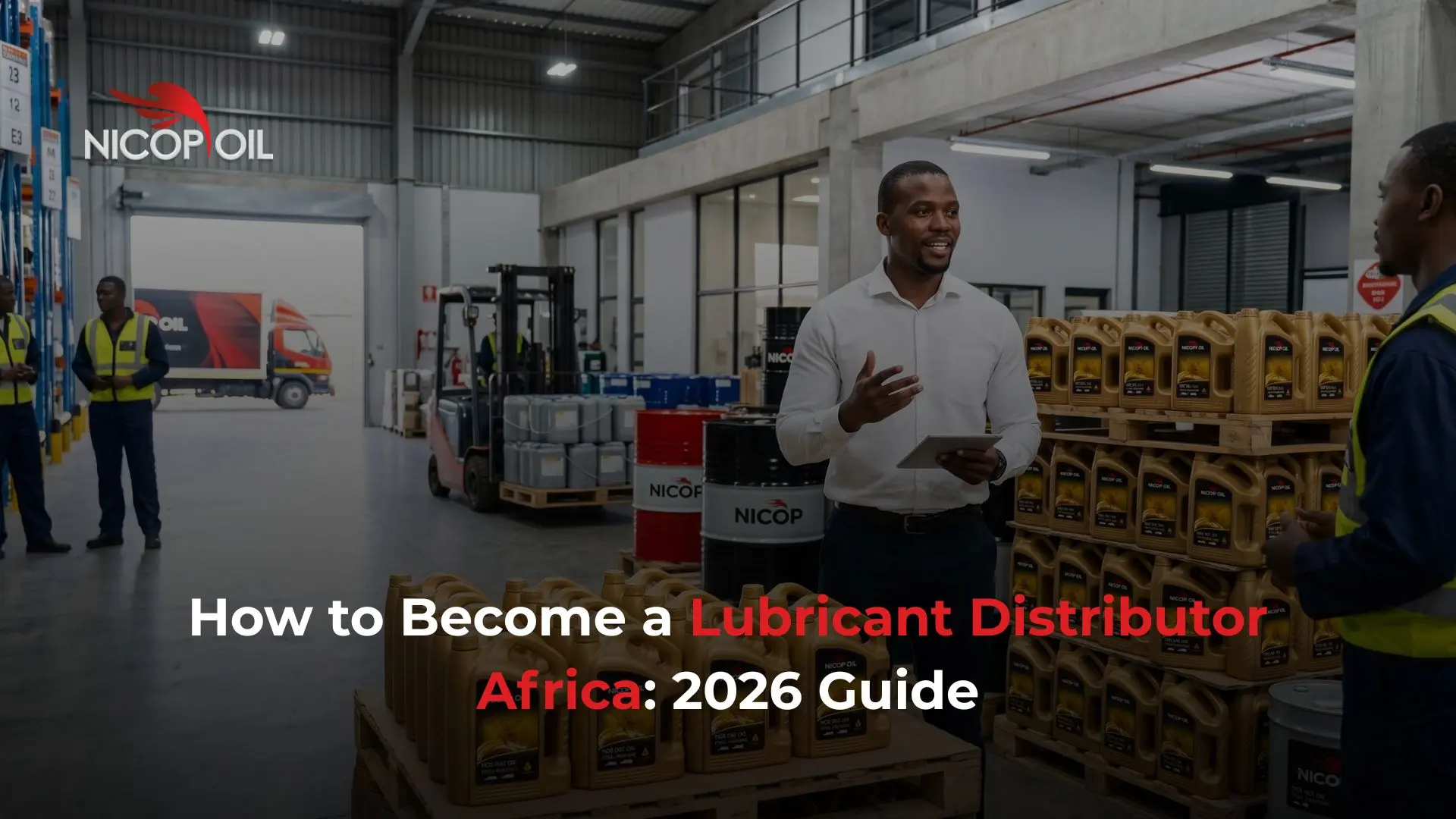
Africa burns through more than 2.5 billion litres of lubricants every year, and that number keeps climbing. Trucks haul goods across borders. Construction sites run heavy machinery from dawn to dark. Fuel stations sell oil bottles by the thousands every week. Behind every one of those sales sits a distributor who saw the opportunity early and moved.
If you have been thinking about how to become a lubricant distributor Africa, this guide walks you through everything you need. No fluff. No business-school jargon. Just the real steps, the real numbers, and the real mistakes you want to avoid.
Why Africa Is the Best Place to Start a Lubricant Distribution Business
The African automotive market is growing faster than most regions in the world. Cameroon alone imports thousands of vehicles every year, and almost every one of them needs engine oil, transmission fluid, and other lubricants for life.
What makes the lubricant distributor Africa opportunity special right now:
- Vehicle ownership is rising sharply across West, Central, and East Africa
- Construction and mining sectors are expanding fast
- Local production of quality lubricants is still limited
- European and Asian imports dominate the premium segment
- Fleet operators want reliable bulk suppliers they can trust
A friend of mine in Yaoundé started supplying motor oil to two small garages in 2021. Four years later, he supplies seventeen workshops, a fleet of forty trucks, and three fuel stations. He did not invent anything. He just showed up consistently, kept quality high, and answered his phone.
That is the entire game.
Step 1: Understand What a Lubricant Distributor Actually Does
A lubricant distributor Africa sits between the manufacturer and the end user. Your job is to buy oil in large volumes from a supplier, store it, transport it, and resell it to businesses that need it. Those businesses include:
- Fleet operators and trucking companies
- Auto workshops and service garages
- Fuel stations and retail shops
- Construction and industrial sites
- Wholesale buyers who resell to smaller markets
You make money on the margin between your purchase price and your selling price. You also earn loyalty by offering credit, fast delivery, and technical advice that pure manufacturers cannot.
For more on how this works in practice, the synthetic vs mineral oil breakdown is worth a read. It explains what your future clients actually buy and why.
Step 2: Pick the Right Product Category to Focus On
Not every product makes sense for every market. A new lubricant distributor Africa should pick a focus instead of trying to sell everything from day one.
The main categories you can start with:
| Product Type | Main Buyers | Volume Potential |
|---|---|---|
| Fully synthetic motor oil | Modern cars, premium fleets | Medium, high margin |
| Semi-synthetic oil | Mixed fleets, small workshops | High, medium margin |
| Mineral motor oil | Old vehicles, budget buyers | Very high, low margin |
| Heavy-duty diesel oil | Trucks, buses, mining equipment | High, good margin |
| Industrial lubricants | Factories, construction | Medium, very high margin |
Most successful distributors I have seen start with fully synthetic and heavy-duty diesel oil. Margins are healthier, buyers are loyal once they trust you, and competition from cheap local brands is weaker. The piece on fully synthetic motor oil basics covers why this segment performs so well.
Step 3: Find a Reliable Supplier Before Anything Else
This is the part most new distributors mess up. They register a company, rent a warehouse, print business cards, and then start looking for a supplier. Wrong order.
Before you spend money on anything else, find your supplier first. A solid supplier for a lubricant distributor Africa should offer:
- Genuine European or premium-grade products with proper certifications
- Bulk pricing that gives you healthy margin room
- Reliable shipping schedules to African ports
- Private label or co-branding options for serious distributors
- Technical support when your customers ask hard questions
- Flexible payment terms once you build trust
Nicopoil works directly with a leading European manufacturer and supplies bulk motor oils across Cameroon and Central Africa. For new distributors, partnering with a supplier that already knows the African market saves months of trial and error. The Why Choose Nicopoil page lays out what a serious distributor relationship looks like.
When you evaluate suppliers, ask for API and ACEA certifications. These are international quality standards. You can verify what they mean directly on the American Petroleum Institute website. If a supplier cannot show you these certifications, walk away. Counterfeit and low-grade oil destroys engines and destroys your reputation faster than anything else.
Step 4: Register Your Business Properly
You cannot operate as a lubricant distributor Africa without legal registration. Requirements differ by country, but the basics stay similar:
- Register a limited liability company or sole proprietorship
- Get a tax identification number
- Apply for an import license if you plan to bring in products from abroad
- Register for VAT or local sales tax
- Open a business bank account
- Get warehouse permits if you store flammable products
In Cameroon, this process typically takes two to six weeks if your paperwork is clean. Budget around 200,000 to 500,000 CFA for registration, licenses, and initial compliance. Other African countries have similar ranges.
If you plan to import directly, you also need to understand customs procedures. Working with a clearing agent for your first few shipments is worth every franc. They know the small details that can hold your container at port for weeks.
Step 5: Set Up Storage and Logistics
Motor oil is heavy. A single 208-litre drum weighs around 180 kilos. You need a real warehouse, not a back room.
Minimum requirements for a starting lubricant distributor Africa:
- Covered warehouse space, at least 50 square metres for a small operation
- Concrete flooring with proper drainage and spill containment
- Forklift or pallet jack access for moving drums and barrels
- Adequate ventilation to handle vapours
- Fire safety equipment and clear emergency exits
- Secure entry with limited access to authorised staff only
For transport, you have three options. Buy your own delivery truck, rent vehicles as needed, or partner with a local logistics company. Most new distributors start with rentals and graduate to owned trucks once monthly volumes justify the investment. The article on bulk engine oils for fleet owners shows how bigger operators handle this scale.
Step 6: Build Your Customer Base From Day One
Here is the truth nobody tells you. The product sells itself once you have customers. Getting those first customers is the hard part.
A lubricant distributor Africa can build their customer base through a few proven channels:
Direct visits to workshops and fuel stations. Print a simple catalogue. Walk in. Show samples. Leave your number. Repeat with twenty businesses a week for a month. You will close at least three or four.
Partnerships with fleet managers. One fleet manager controls dozens of vehicles. Build relationships with three or four, and your volume problem is solved.
Referrals from happy customers. This is the slowest but most reliable channel. Take care of your first ten customers obsessively, and they will bring you the next thirty.
Local advertising in trade publications. Trucking magazines, auto trade groups, and industry WhatsApp groups all reach buyers cheaply.
For background on what your customers actually look for in a product, the oil viscosity guide is the kind of technical knowledge that wins respect during sales calls.
Step 7: Price Smart, Not Cheap
New distributors love to compete on price. Most go broke doing it.
A profitable lubricant distributor Africa prices based on three factors:
- Your landed cost per litre, including shipping, duties, and storage
- Your operating expenses divided by expected monthly volume
- The price gap between your product and the next viable alternative
If a cheap local brand sells at 1,800 CFA per litre and a premium imported brand sells at 3,500 CFA, your sweet spot is usually somewhere between 2,400 and 2,800 CFA. You offer better quality than the cheap stuff and a real saving compared to the premium import.
Volume discounts matter too. Fleet operators expect tiered pricing. A buyer purchasing 5,000 litres a month should pay noticeably less per litre than a workshop buying 200 litres.
Step 8: Master the Technical Side
You do not need to be a chemist. But you do need to know your products better than your customers do. The 10W-40 vs 5W-30 comparison is a good example of the technical detail that builds credibility with serious buyers.
A working lubricant distributor Africa should be able to answer questions like:
- What oil grade is right for a Toyota Hilux 2018 model?
- Why does diesel engine oil need different additives than petrol oil?
- What does ACEA A3/B4 actually mean on a product label?
- How often should engine oil be changed in tropical climates?
- What signs show that oil is breaking down and needs replacement?
The signs your engine oil needs changing piece covers exactly this kind of practical knowledge. Read it. Memorise it. Quote it back to your customers when they ask.
Step 9: Handle Common Mistakes Before They Cost You Money
Three mistakes destroy more new distributors than anything else.
Buying too much stock too soon. A new distributor sees big margins and orders five containers. The product sits in the warehouse for nine months. Cash is dead. The business dies.
Start small. Order what you can sell in 60 to 90 days. Reorder as demand confirms itself.
Giving credit to the wrong customers. Everyone wants 30-day payment terms. Almost nobody pays on time. New distributors give credit to anyone who asks, then spend half their time chasing money instead of building the business.
Cutting corners on quality. Some distributors mix premium oil with cheaper bulk product to boost margins. Customers always find out. One bad batch can end a business that took years to build.
Sell what you buy. Document everything. Protect your reputation as if it were the only asset you have, because in this business, it is.
Step 10: Plan for Growth From the Start
The first year of being a lubricant distributor Africa is about survival. The second year is about systems. The third year is where real money starts to compound.
Once you have a steady cash flow, the natural expansion paths are:
- Add complementary products like gear oil, brake fluid, and coolant
- Expand into neighbouring cities or countries
- Develop your own private label brand
- Acquire smaller competitors who are struggling
- Move upstream into direct importing if you started as a sub-distributor
A distributor I spoke with in Douala started with 200 litres a month in 2019. Today, he moves 18,000 litres a month and supplies three border countries. He never did anything dramatic. He just kept the trucks moving and reinvested almost everything for the first five years. The private label motor oil manufacturers article explains the path he eventually took to build his own brand.
What Real Profit Looks Like in This Business
Numbers vary by country and product mix. But for a lubricant distributor Africa moving between 5,000 and 15,000 litres a month, realistic financials look something like this:
| Metric | Range |
|---|---|
| Revenue per litre | 2,400 to 3,200 CFA |
| Gross margin | 25% to 40% |
| Monthly volume after Year 1 | 5,000 to 10,000 L |
| Monthly volume after Year 3 | 15,000 to 40,000 L |
| Initial investment needed | 8 to 25 million CFA |
| Break-even timeline | 8 to 18 months |
These are not guarantees. They are what I have seen in real conversations with real distributors across Cameroon, DRC, and Gabon. Your numbers will depend on your effort, your supplier relationship, and how hard you work in the early months.
FAQs
Can I sell lubricants online or do I need a physical shop?
You can run a lubricant distribution business without a retail shop, but you cannot run it without warehouse space. Most B2B sales in Africa happen through direct visits, WhatsApp orders, and phone calls rather than e-commerce platforms. Fleet operators, workshops, and fuel stations want to inspect products, negotiate prices in person, and have stock delivered to their location. A simple website helps with credibility, but the real selling still happens offline.
How long does it take before a new distributor starts making real profit?
Most lubricant distributors break even somewhere between 8 and 18 months. The first six months usually involve heavy customer acquisition with thin margins. By month 12, recurring orders from regular customers cover fixed costs. Real profit typically starts flowing in year two, once you have 15 to 25 steady B2B clients and predictable monthly volume. Distributors who push for fast profits by cutting quality almost always fail within the first year.
What is the difference between being a distributor and being an authorized dealer?
A distributor buys products in bulk and resells them freely to any business they choose, often handling multiple brands and product lines. An authorized dealer represents one specific brand under a formal agreement, with exclusivity rights in a defined territory and stricter rules around pricing and marketing. Distributors enjoy more flexibility and supplier options. Dealers get brand support, training, and territory protection but accept tighter operational control. Most new entrants in Africa start as distributors and graduate to authorized dealerships once they prove volume.
What are the biggest risks in the lubricant distribution business in Africa?
The three biggest risks are unpaid customer credit, counterfeit products entering your supply chain, and currency fluctuations on imported stock. Many B2B buyers in Africa expect 30 to 60-day payment terms, and chasing late payments can drain your cash flow within months. Counterfeit motor oil from grey-market sources looks identical to genuine product but destroys engines, and one bad batch can permanently damage your reputation. For distributors who import directly, sudden devaluation of local currency against the Euro or US Dollar can wipe out an entire shipment's margin overnight. Smart distributors protect themselves with strict credit policies, supplier verification through API and ACEA certificates, and hedging or pricing buffers on imported stock.
The Bigger Picture for African Distributors
Africa’s lubricant market will keep growing for the next decade. Vehicle imports keep rising. Industrial activity keeps expanding. Construction sectors keep absorbing equipment that needs oil to run. The distributors who position themselves now will own meaningful market share by 2030.
Becoming a successful lubricant distributor Africa is not about having connections or starting capital that nobody else has. It is about picking the right supplier, focusing on quality, building customer trust slowly, and refusing to take shortcuts. The market rewards patience and punishes greed in this industry, almost without exception.
If you are serious about taking the first step, the most important move is finding a supplier who already understands the African market and can support you as you grow. Everything else is execution.